The Best Time of Year to Build a Deck in Wisconsin, and When to Book It
Table of Contents
- Introduction
- Why the Booking Calendar Matters More Than the Weather
- Spring: Wet Ground Is the Real Constraint
- Summer: Long Days, Full Schedules
- Late Summer Into Early Fall: The Best Build Window
- Winter: The Right Time to Plan, Not to Dig
- Frozen Ground, Footings, and Cold Weather Concrete
- Installation Temperature Changes How Boards Are Gapped
- When You Can Actually Stain or Seal
- Permits and Lead Times Shift by Season
- Building Backward From When You Want to Use It
- Conclusion
- Get on Next Season's Schedule
- Frequently Asked Questions
Key Takeaways
- Late summer into early fall is the best build window here. Ground is dry and workable, temperatures are moderate, and the peak booking rush has passed.
- Spring is the wettest, softest ground of the year, which affects excavation, equipment access, and open footing holes more than most people anticipate.
- Winter is for planning, permitting, and booking rather than building. Frozen ground and cold weather concrete requirements are the reasons.
- Contractors fill their season during winter. Calling in May for a summer deck usually means a fall build.
- Cold weather concreting costs more rather than less, since it needs heated materials, insulation, and protection from freezing.
- Composite boards installed in cold weather need larger end gaps, because they will expand when warm.
- A deck built in October generally cannot be stained until the following spring, since most products need sustained temperatures above about fifty degrees.
Introduction
The best time to build a deck in Wisconsin is late summer into early fall, when the ground is dry enough to dig and drive on, temperatures are moderate for both materials and crews, and the spring and summer booking rush has cleared. The best time to arrange it is the winter before.
Those are two different answers to two different questions, and conflating them is why so many people end up disappointed. Weather determines the ideal conditions for the work. Contractor schedules determine when the work can actually happen. In practice the second one governs, because a perfect August window is worth nothing if every builder in the area was fully booked by March.
This also cuts against some common advice. Spring gets described as an ideal starting season, when it is in fact the muddiest and least workable ground of the year. Winter gets described as feasible for construction, when the frozen ground and cold weather concrete requirements make it the season most builders will not pour footings in.
What follows covers each season honestly, the technical reasons behind them, and how to work backward from when you actually want to use the deck. Anyone planning deck building in this climate benefits from starting that conversation considerably earlier than feels necessary.
Why the Booking Calendar Matters More Than the Weather
The single most useful fact in this article, and it is usually buried in a tip box somewhere.
Deck builders fill their season during winter. Consultations, designs, and contracts signed in December through February become the spring and summer build schedule. By the time the weather turns pleasant, the calendar is largely spoken for.
What this means in practice:
- Call in January and you are choosing your build window.
- Call in April and you are taking what remains, often late summer.
- Call in May or June for a summer deck and you are usually looking at fall.
- Call in August and you may be looking at next year, particularly for larger projects.
Why it works this way. Wisconsin has a short workable season. Crews compress a year of production into roughly seven or eight months, so the schedule fills front to back and there is little slack. A rain week in June pushes everything behind it.
The corollary: the homeowners who get the best build window are not the ones who chose the best season. They are the ones who booked earliest.
If you want a deck for summer, the decision point is the preceding winter, not the spring.
Spring: Wet Ground Is the Real Constraint
Spring is when demand peaks and when site conditions are at their worst. Both of those are worth understanding before assuming it is the natural time to start.
What actually happens in a Wisconsin spring:
The ground is saturated. Snowmelt plus spring rain, on soil that is still thawing from below. This is the softest, wettest condition of the year.
Excavation is harder, not easier. Post holes in saturated soil collapse, fill with water, and sometimes need re-digging. Since the footing inspection has to happen before concrete goes in, a hole that fills overnight can cost a day.
Equipment access damages lawns. Driving a machine across a saturated yard produces ruts that take a season to recover. Sometimes the honest answer is waiting a week.
Rain delays compound. Spring has the most weather interruptions, and each one pushes the whole schedule.
Frost is still leaving the ground into early spring, and heave conditions persist longer than the air temperature suggests.
What spring is genuinely good for: the second half of it. Late spring, once things have dried out, is a reasonable build period. And it is the right time to finish and stain a deck built the previous autumn.
What it is not: an ideal starting condition. The common claim that spring offers ideal conditions applies to air temperature and not to the ground you have to dig.
Summer: Long Days, Full Schedules
The busiest season, and workable, with real trade-offs.
Advantages:
- Long daylight means longer productive days
- Ground is dry and workable
- Predictable stretches of weather with fewer washouts
- Warm enough for staining and sealing, which is genuinely useful
Challenges:
- Schedules are full. This is the constraint, not the weather.
- Heat affects concrete. Hot weather causes concrete to lose moisture rapidly, which can reduce strength and cause surface cracking. It requires its own precautions rather than being the easy condition people assume. Fast curing is not the same as good curing.
- Heat affects crews and materials. Composite and dark surfaces get very hot, and productivity drops in extreme heat.
- You lose the use of your yard during the season you most want it.
Best fit: homeowners who booked the previous winter and want to watch the build happen in good weather.
Within summer, the shoulders are easier than the middle. Early June and late August avoid peak heat and humidity.
Late Summer Into Early Fall: The Best Build Window
If conditions alone decided it, this is the answer, and it is worth understanding why rather than calling it a hidden gem.
The ground is at its driest and firmest. After a summer of drying, excavation is straightforward, holes hold their shape, and equipment can cross a lawn without wrecking it. This is the single biggest practical advantage and it matters more than air temperature.
Temperatures are moderate. Comfortable for crews, easier on concrete than midsummer, and still warm enough for finishing work.
Humidity drops. Better conditions for staining and sealing, and less moisture in wood at installation.
Demand eases. The spring and summer rush has passed, which means better availability and more attention on your project.
You get a full season of use next year. A deck finished in September is ready the moment spring arrives, rather than being built during the months you wanted to use it.
The constraint is the back end. Start too late and you run into freezing weather during footing work. The deeper into October you go, the more likely concrete needs cold weather measures and the more likely staining waits until spring.
Practical guidance: aim to have footings in the ground by early to mid October. Framing and decking can continue later than that with fewer complications, since the concrete is the temperature-sensitive part.
Winter: The Right Time to Plan, Not to Dig
Winter has genuine value in a deck project, and it is not construction.
What winter is excellent for:
- Design. Unhurried conversations, considered layout decisions, and time to change your mind before anything is committed.
- Permitting. Building departments are far less busy than in spring, so review times are shorter.
- Material selection and ordering. Supplier lead times are shorter and there is time to see samples rather than choosing from a photograph.
- Booking. This is the decisive one. Winter is when the coming season's calendar gets filled.
- Budgeting. Time to price the project properly and decide what is in scope.
There are good reasons that winter is the right time to plan a deck project even though it is the wrong time to build one, and the distinction is worth holding onto.
What winter is not good for: digging and pouring, for the reasons below.
On the claim that winter construction is cheaper: not for anything involving concrete. Cold weather work requires additional measures that add cost rather than removing it. Where winter genuinely saves money is in having time to plan properly and in not paying a premium for a rushed schedule.
Frozen Ground, Footings, and Cold Weather Concrete
The technical reasons winter construction is limited, which the usual advice tends to wave at rather than explain.
Footings must reach below frost depth, commonly around four feet in this area, confirmed locally. That is the whole point of them, since soil that freezes expands and lifts anything sitting in the frozen zone.
In deep winter, the ground is frozen well down. Digging through it requires ground thawing equipment or heavy machinery, which adds time and cost. This is the practical obstacle, and it is why the caveat about the ground not being frozen solid is doing more work than it appears.
Concrete has temperature requirements. Fresh concrete that freezes before it has gained enough strength is permanently compromised. Cold weather placement generally requires some combination of heated mixing water, accelerating admixtures, insulated blankets, and sometimes heated enclosures, with the concrete protected for a period after placement.
All of that costs money. Cold weather concreting is a premium, not a discount.
Frozen ground also affects bearing. A footing poured onto frozen soil sits on something that will change when it thaws.
One genuine winter capable option: helical or screw piles, which are driven rather than dug. They can often be installed in conditions that make excavation impractical, they generate no spoil, and they can be loaded immediately. They cost more than poured footings in ordinary conditions, and they are a legitimate answer where a winter or early spring start genuinely matters.
What can proceed in cold weather once footings are in: framing, decking, and railings. Carpentry is far less temperature-sensitive than concrete. So a deck whose footings went in during autumn can reasonably be completed later than most people expect.
Installation Temperature Changes How Boards Are Gapped
A technical detail that affects how the deck looks and performs for its whole life, and one almost nobody mentions.
Materials expand and contract with temperature, and composite does so more than wood along its length.
Install in cold weather and boards are at their shortest. They will expand as temperatures rise, so end gaps need to be larger to accommodate that. Gap them as you would in summer and the boards will push against each other and buckle.
Install in hot weather and boards are already expanded. Gaps can be smaller, because the boards will contract rather than grow.
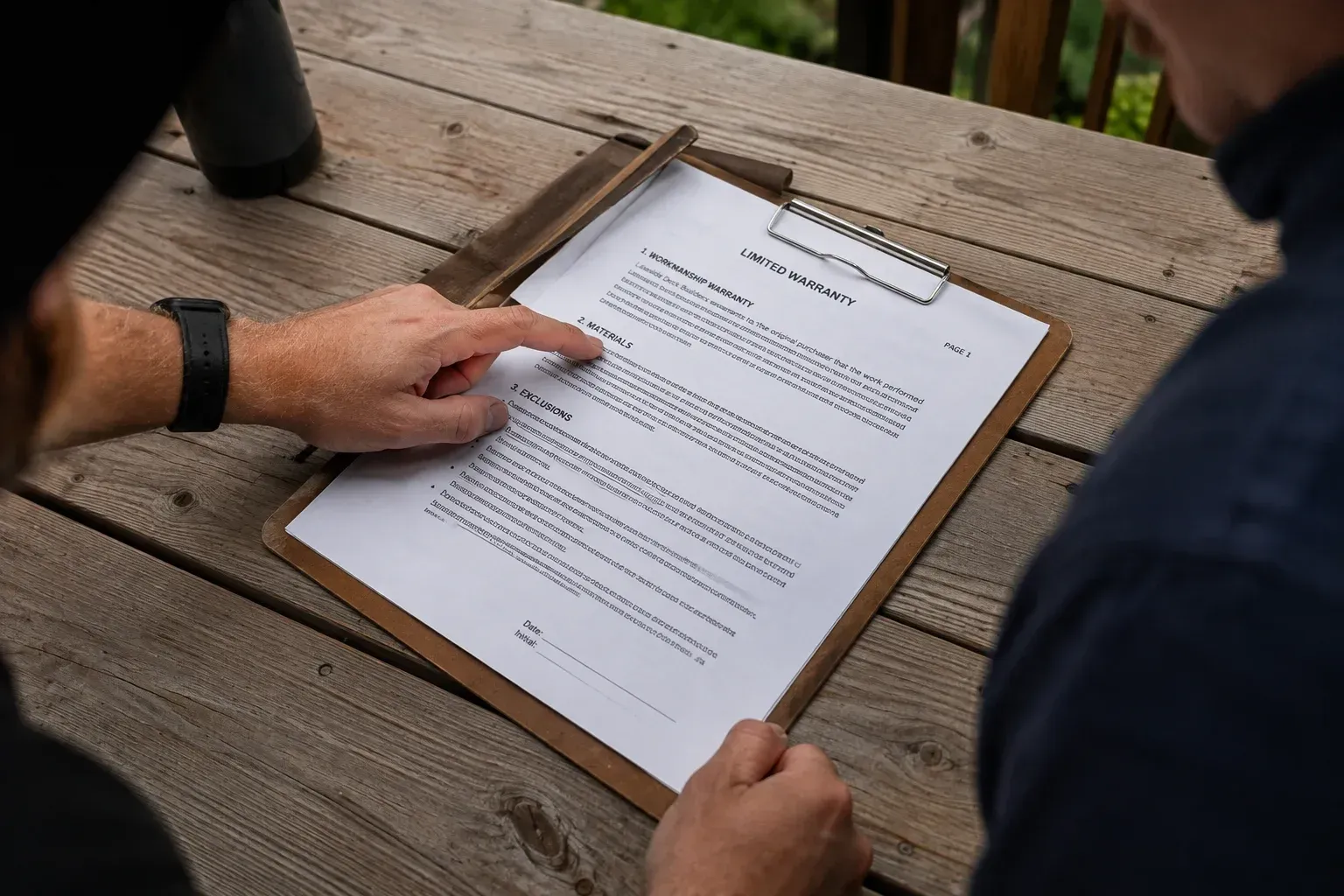
Manufacturers publish gapping tables keyed to installation temperature. This is not guesswork and it is not optional. It is one of the more common warranty issues with composite decking.
Treated lumber has a different problem. Lumber delivered wet from treatment shrinks as it dries, so boards installed tight will open up over the following months. Kiln dried after treatment material is stable and gets gapped normally at installation. Knowing which you have changes the spacing.
Why this matters for timing: it is not a reason to avoid any particular season. It is a reason to use an installer who accounts for it, and a reason not to assume that gaps that look right on installation day are right.
When You Can Actually Stain or Seal
This catches people out, particularly on autumn builds.
Most stains and sealers need sustained temperatures above roughly fifty degrees during application and for a curing period afterward, with no rain in that window and overnight temperatures that do not drop too far.
In Wisconsin, that window closes well before the build season does. By mid to late October, reliable staining conditions are usually gone.
Treated lumber needs to dry first regardless. Wet treated lumber will not accept stain properly, and depending on the material and the weather this can take weeks or months. The usual field test is whether water beads on the surface or soaks in. Beading means it is not ready.
So the realistic sequence for an autumn build is construction in September or October, and staining the following spring or early summer once the wood has dried and temperatures are reliable.
That is not a problem. Pressure treated lumber tolerates a winter unfinished. It just needs to be planned for rather than discovered.
A summer or late spring build can often be stained the same season, provided the lumber has had time to dry.
Composite needs none of this, which is one of its practical advantages for a late season build.
Permits and Lead Times Shift by Season
Timing affects the paperwork as much as the construction.
Spring is the bottleneck for permit review. Everyone applies at once, and review times stretch. Applying in late winter for a spring or summer build avoids most of the queue.
Winter is the fastest for review, since building departments are handling far fewer applications.
Requirements and processing times differ by municipality. Milwaukee, Waukesha, Brookfield, Germantown, Menomonee Falls, Oak Creek, and Franklin each run their own department. The permit process and what it requires is worth understanding before you set a target date, since a resubmission can cost weeks.
Utility locates are seasonal too. Requests surge in spring, and the required notice period does not compress. Build the lead time into your schedule rather than treating it as a same week task.
Material lead times are shortest in winter and longest during peak season, which matters if you have specified something that is not held in stock.
Building Backward From When You Want to Use It
The most practical way to plan, rather than asking which season is best.
If you want to use the deck next summer:
- Consultation and design in December or January
- Contract and permit application in January or February
- Review completed before the spring rush
- Build in late spring or early summer
- Stain in mid to late summer if it is wood
If you want it finished this year and are starting in spring:
- Book immediately, and expect a late summer or early autumn slot
- Footings in by early to mid October
- Plan on staining next spring
If you are flexible and want the best conditions:
- Book in winter for a late August or September build
- Best ground conditions, moderate temperatures, and a full following season of use
If something forces a winter start:
- Discuss helical piles as an alternative to poured footings
- Expect cold weather measures and the cost that comes with them
- Accept that finishing work will run into spring
One consistent piece of advice across all of these: the design and budget conversation is worth having earlier than the build conversation, and it costs nothing to start. Knowing what your project is likely to cost before you are trying to book a slot makes the whole sequence easier.
Conclusion
Two answers, for two different questions. The best conditions for building a deck in Wisconsin are late summer into early fall, when the ground is dry and firm, temperatures are moderate, and the busy season has eased. The best time to arrange it is the winter before, because that is when builders fill the coming year's calendar.
The common advice gets two things backward. Spring is not an ideal starting condition, it is the wettest and softest ground of the year, which affects excavation and access more than air temperature does. And winter is not a discounted construction season, because frozen ground and cold weather concrete requirements add cost rather than removing it. Winter is for design, permits, material selection, and booking, all of which it is genuinely excellent for.
The practical takeaway is to separate the two decisions. Decide what you want built and get it designed and permitted during the quiet months. Then take the best available build window rather than hoping one opens up in the season you happened to start thinking about it.
Get on Next Season's Schedule
If you are thinking about a deck for next year, the design and permit work is best done now rather than in spring, when both the building departments and the build calendar are at their busiest. A first conversation covers what you want, what your lot allows, and a realistic timeline. You can
get in touch through our contact page or call (262) 221-4321.
Frequently Asked Questions
What is the best month to build a deck in Wisconsin?
Late August through September. The ground is at its driest and firmest for digging footings, temperatures are moderate, humidity has dropped, and the peak booking rush has passed. Aim to have footings in before mid October.
Can you build a deck in winter in Wisconsin?
Framing and decking can continue in cold weather, but digging and pouring footings is the obstacle. Frozen ground needs thawing equipment, and concrete requires cold weather measures. Helical piles are a genuine alternative.
How far in advance should you book a deck builder?
For a summer build, the winter before. Contractors fill their season between December and February, so calling in May for a summer deck usually means a fall slot. Larger projects need more notice.
Can you pour concrete footings in cold weather?
Yes, with precautions including heated mixing water, admixtures, insulation, and protection from freezing while the concrete gains strength. It costs more rather than less, so winter is not a discount season for anything involving concrete.
When should you stain a new deck?
Once the wood is dry and temperatures stay reliably above about fifty degrees. Treated lumber often needs weeks or months to dry first. A deck built in autumn is usually stained the following spring rather than the same season.
Explore More Blogs